I won free tickets to Woody Allen’s new film, “Magic in the Moonlight” from the Dublin Theatre festival. Mr. Waffle and I went this evening. It was unremittingly awful. Don’t go. Ironically, it might make a better play.
More holiday soon.
I won free tickets to Woody Allen’s new film, “Magic in the Moonlight” from the Dublin Theatre festival. Mr. Waffle and I went this evening. It was unremittingly awful. Don’t go. Ironically, it might make a better play.
More holiday soon.
Actually we have been back some time but my evenings have been filled with brasso and stair rods (more of this anon). So three weeks of holidays and you are desperate to know how it went. I know, I know. A full account begins here. There could be days of this, so pace yourself.
30 July
Our heroes leave home. The house is immaculate for the French family with whom we are swapping houses. We turn on the dishwasher one last time. The Princess asks innocently, “Why is there water coming out from under the cooker?” Why indeed? The dishwasher had leaked behind the presses and litres of water were slowly seeping out from underneath. When we pulled out the dishwasher there was a flood. We mopped it up as best we could. We had a ferry to catch and all we could do was leave a note to the French people apologising for the smell and asking them not to use the dishwasher. A poor start. It also made us a bit later than expected so instead of pulling off the main road to have a nice picnic on the grass, we ate our sandwiches in the car in a small lay-by with juggernauts hurtling alongside us. In addition, Mr. Waffle had to field a number of work calls. Still we made the ferry. All in all, not a triumph though.
31 July
We arrive in La Belle France. Happily we are staying relatively near the ferry port. Mr. Waffle reaches for his immensely detailed map of Finistère (scale 1:1) to find that he has forgotten it. All we have is a tourist map of Brittany. Alas. A text comes in from our next door neighbours: “Do the French people have a chubb key for the door? You have only given us the latch key and you have double locked the door. Don’t worry, the cat came into us to be fed.” There followed much anguish as a) Mr. Waffle tried to remember whether he had posted both keys to the French people and b) we realised that the only spare chubb key in Ireland was inside the house.
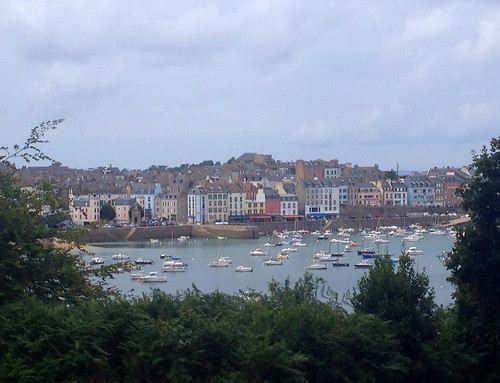
Things began to look up when we arrived at the house. It was in Douarnenez which is a very red town. It is twinned with somewhere in Palestine and it’s history is one of industrial unrest.
The house looked promising.
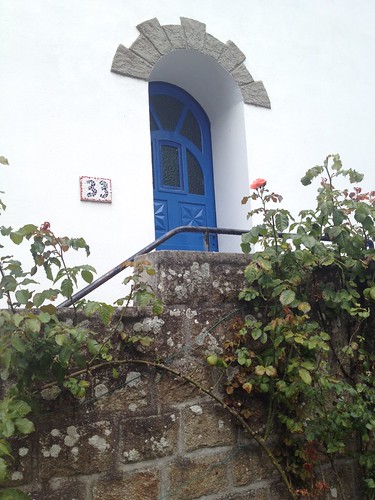
It was great. It had a laptop in every room (except Daniel’s – source of great grief), table tennis in the basement, bikes, scooters, surf boards, snorkeling gear and all the accoutrements of family life.
The children instantly sat up on the swivel chairs at the breakfast bar and began to swivel.
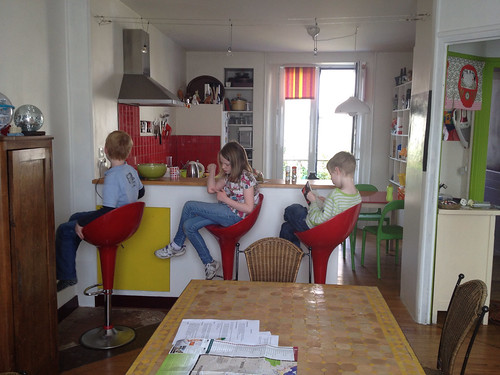
They stopped but not before one of them fell off and broke a chair. Then another child broke a mirror in the basement while playing table tennis. Attempts to remedy both of these were unavailing. The only glass maker in the greater Finistère area was on holidays until the end of August and he wasn’t about to come back for us. This led to great anguish until we gave up and phoned the French people and confessed our sins. They were very kind and not at all put out – apparently.
1 August
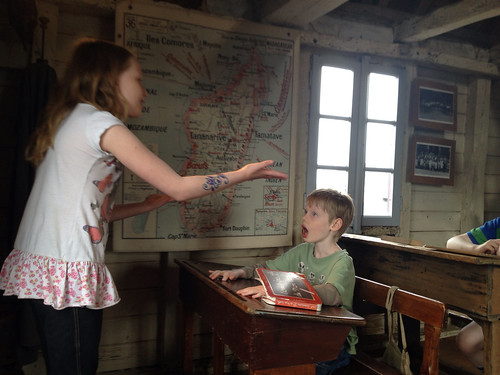
Daniel and Herself went out together to the boulangerie in the morning to get bread and croissants and were pleased with the success of the venture. They got us breakfast every morning for the remainder of the holiday. Later we walked into the indoor market, in the centre of town. In the afternoon we went to the beach and then went to Pont Croix for a cup of tea and a tour of the oldest house in town. The top floor was kitted out as an old fashioned school room and the children acted as you might expect.
2 August
We went to the Pointe du Van which is pretty and not filled with tourists. While I was waiting for the children and Mr. Waffle to catch up, I overheard a French grandfather filling in his grandson on the actions of his grandparents in the second world war (one killed in the fighting). Then a group of German tourists went by chatting away. It’s still a little strange, isn’t it; although I assume that the French are used to it.
And then on to Pointe du Raz which is beautiful but has far more tourists per square inch than Pointe du Van. Arty shots below taken to give the impression we were alone when, in fact, we were practically surrounded on all sides.
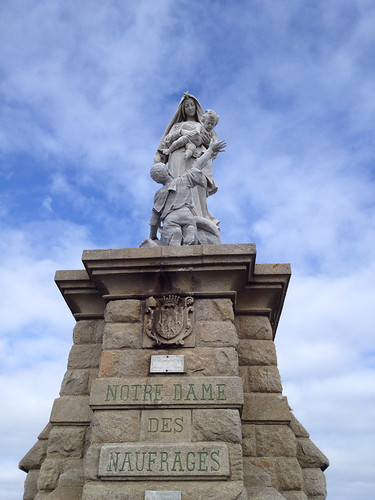
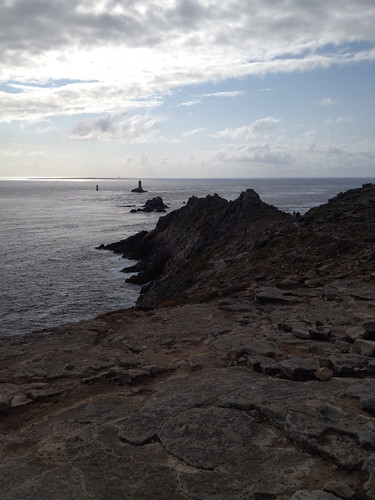
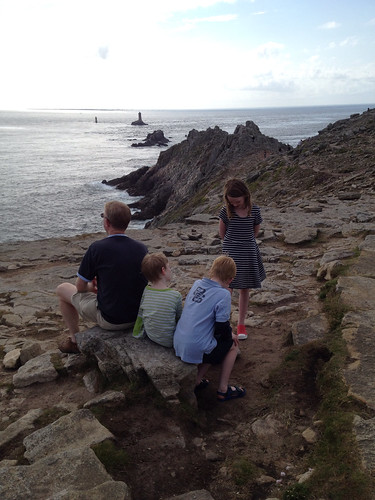
As the afternoon wore on, it got a little less busy and it was more possible to take in the beautiful view without jostling other tourists.
3 August
We went to mass. Mass in French. Long mass in French. The children were appalled. In the row in front of us there was a French family with many children. I hissed to mine that they were to admire the behaviour of the French children and emulate (what I assumed would be) their general air of resigned saintliness. My children were quite saintly actually but the children in front were dreadful. I have never seen such poorly behaved French children. Two of the boys who were about the same age as mine began to have a vicious sotto voce argument and then one smacked the other sharply (and loudly). We were amazed; especially when the father started to laugh. As Michael observed sagely, there was no way his father would have laughed if he and his siblings had been smacking each other. At the end of mass, the mother turned around and started chatting to us and asking us where we were from and whether we were Catholics. Really, you need to ask?
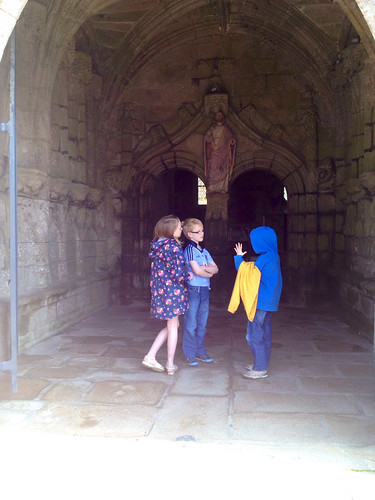
Across the road was a graveyard where the man who invented the stethoscope was buried; in the interests of family harmony we decided not to investigate.
August 4
I had not really thought through the implications of the Princess having a laptop in her bedroom. Inter alia we heard about: the extent of the British empire at its height; the patron saints for everything; the time it takes to fly to Scotland and six historical events that never happened.
We went out to the brocante in desperation. She bought herself a t-shirt from a man from Harold’s Cross in Dublin (relocated to Brittany) who turned out to be a cousin of a colleague of mine. Then we saw a friend’s sister and her family in the supermarket. Small world and all that.
We also had the obligatory summer Breton experience of Jeux Bretons [inevitably disappointing games played with things hewn from wood – a low light here was throwing the stone in the clog].
August 5
We went for a cycle in the park at the top of the road and had a look at the Roman fish factory. Your point?
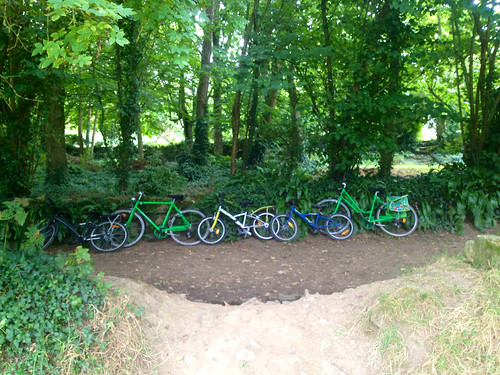
The bicycles which the French people had left for us were a little tired and as we cycled into the park, a very tattoed French man emerged from his house near the entrance and tut tutted about our state of readiness. He turned around Mr. Waffle’s wheel which apparently was back to front and pumped up my bike and Mr. Waffle’s. We were a bit taken aback by all the French friendliness. Our previous experience of French people had not led us to the conclusion that they were a warm, friendly, welcoming bunch. They have other strengths. Possibly being a communist town makes you friendly – maybe tourists are a novelty? We remained baffled.
I nipped into town later in the afternoon and to my intense astonishment there browsing in the shops was my friend the Glam Potter. The Glam Potter and I had been very friendly in Brussels as the Princess and her daughter were born within six weeks of each other. We saw an awful lot of each other but then I moved back to Dublin and she moved to England and we lost touch a bit – it was such a shock to see her. It was even more of a shock to see her daughters who were six years older than when I had seen them last. They were on holidays for a couple of days and I invited them all round to dinner the following evening.
August 6
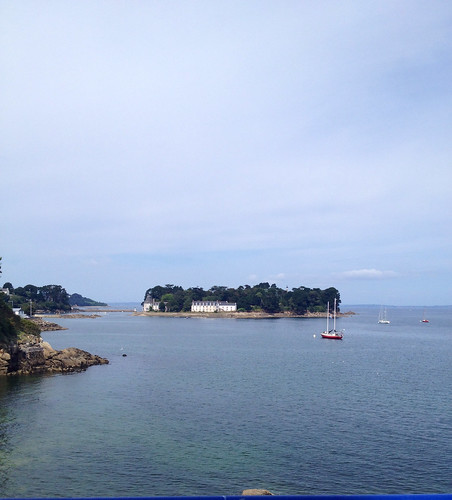
We went out to visit the island – Ile Tristan – from which the town gets its name. Apparently Douarnenez means land belonging to the island. It was pretty and mildly interesting but an hour and a half is a long time to spend learning about the flora and fauna on a small island. Our only saving grace was that the GP and family turned up also and the children were able to inspect each other with mild interest.
That evening we had our friends for dinner. It was so nice, we were all very nostalgic about Brussels and got to canvas the Scottish independence question. She is as Scottish as someone who grew up in Antigua can be. They pointed out that the house was just like millions of bohemian houses in Saint Gilles (slightly arty Brussels suburb) and it really was. More nostalgia.
August 7
We were recovering from our dinner the previous evening and we had a mild trip to the beach and I went for a cycle round the town but that was largely it.
August 8
It rained and rained. We went into Quimper and got rained on all day.
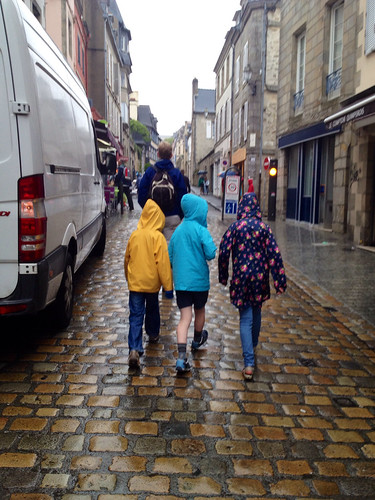
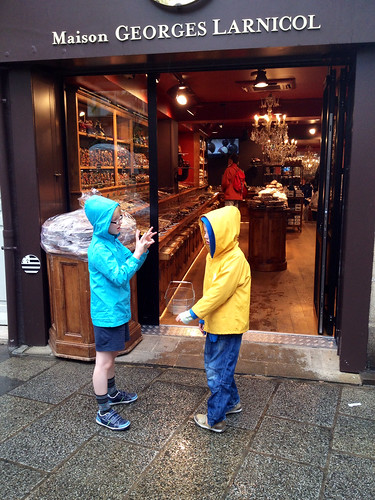
Mr. Waffle heroically volunteered to take the children on the tourist train that drove around the town while I went to see a very beautiful exhibition on Japanese art and its impact on French painting. He had his reward, however. We have been to Brittany loads of times and while we are there we read Ouest France every day. It is the most local of local newspapers. It is tailored for each town and, you know, “library gets 6 new books” could easily be a half page feature. We have attended innumerable fest-nozs and we have never featured. Our wait, however, was over. The next day, Mr. Waffle and the children were on the front page of Ouest France, true, the picture was small but, if you knew what you were looking for, you could see them, sitting patiently in the train in the rain waiting for it to depart.
A la une! pic.twitter.com/yx2ZnrPFtM
— Anne (@Belgianwaffle) August 9, 2014
En détail. pic.twitter.com/781ZzpFYSN
— Anne (@Belgianwaffle) August 9, 2014
That’s probably enough excitement for today. More in a bit, if you’re good.
My (Irish) friend was giving expert evidence to a House of Lords committee recently. She decided that they were all lords and could be addressed as such, so, following one man’s intervention, she said as “Lord X said…”. The clerk of the committee passed her a note. On it was written “viscount”.
My father often used to say to us when we were children “you are brought up too soft”. You might imagine that on this basis he himself was brought up in conditions of penury and hardship and went barefoot to school but in fact, he grew up in a large house at the bottom of the road where my parents’ house is now. As far as I know, he had access to shoes at all times. So, given my father’s relative affluence, I felt his tendency to assert that we were too soft was inappropriate.
The other day, herself wanted to squeeze some lemon juice. The electric juicer was in the dishwasher so I hauled out the manual juicer from the back of the press. She looked at it a bit dubiously. I went back to reading the paper. After a while she said plaintively, “How does this work?” I looked and she was holding the lemon daintily on top of the squeezer waiting for the squeezer to work its magic. “You have to twist it down.” “What?!” Brought up too soft.
Previous correspondence with my sister.
Me: How’s Spain?
Her: Fine, I imagine but I don’t know as I am in Germany.
In my defence, she has a very heavy travel schedule. She recently returned from India.
Me: How was it?
Her: Oh, fine. Horrible hotel room.
Me: Why?
Her: In India, the way they make a non-smoking room is to take out the ashtrays.
And then the next week, she was in Abbeyfeale. It’s just non-stop.
“The Cuckoo’s Calling” by Robert Galbraith
“The Silkworm” by Robert Galbraith
These are books 1 and 2 in JK Rowling’s detective series. I really enjoyed both books and I think that they are very well plotted and competently written. For my money, book 1 was better than book 2. Book 2 was a bit flabby and overlong. Nearly 500 pages for a standard detective novel is just too much. The first novel is set in the world of celebrity models and the second in publishing. I can’t say I know a lot about either milieu but the first struck me as more authentic. Still, the relationship between the two main characters is really well done and engaging. I will read book 3 when it comes out.
“Death of Yesterday” by MC Beaton
“Death of a Bore” by MC Beaton
Don’t judge me. These are exactly the same as all the other Hamish Macbeth books. Therein lies their charm, I suppose.
“The Farm” by Tom Rob Smith
This is a story written by a man with a Swedish mother and an English father about a Swedish woman who is married to an English man and has an English son. Are you still with me?
The narrator’s Swedish mother may be losing her mind. His parents have emigrated to Sweden after a life in England and his Swedish mother begins to disintegrate. It’s unclear whether the story she tells her son is the result of a disordered mind or whether there is something more sinister afoot. The author manages this really well and it is very difficult to know what is real and what is imagined. I thought the denouement was very clever and satisfactorily explained the story. It is also very competently written. Thematically, it is a bit grim, though, and I am not entirely sure I can say that I enjoyed it.
“How to be a Heroine” by Samantha Ellis
The author talks about some of the books that formed and shaped her as a reader and more generally. If you are a reader and were a reading child, it’s very interesting to see some of your old favourites taken by the scruff of the neck and analysed in detail.
“Greenery Street” by Denis Mackail
My kind sister-in-law gave me a present of this in the Persephone Bookss edition and I was charmed. It is a lovely novel about a young married couple in their first home. The couple are singularly ineffectual, always running out of money and live in fear of their maid whom they call “the murderess”. All their crises, however, are minor ones and happily resolved.
I discovered on reading the introduction that Angela Thirkell, whose books I like very much, was the older and much loathed sister of Denis Mackail. Apparently she was by far the stronger personality of the two. I can see that as there is a sweetness in “Greenery Street” which is entirely absent in Thirkell’s work.
“Love Nina” by Nina Stibbe
This is a very entertaining read but might possibly be even more entertaining, if you were intimate with literary London in the 1980s. Unacquainted as I am with London literary figures, it still made me laugh. Also, Alan Bennett is a lovely man.
“Look Who’s Back” by Timur Vermes
The conceit of this novel, which was a best seller in Germany, is that Hitler wakes up in modern day Germany. Everyone things that he is a Hitler impersonator and he becomes a media darling. It has some very clever and amusing pieces like when Hitler tries to set up an email account (“Adolf Hitler” – No that’s gone – “Reichstag” -That’s gone too – and so on) and when he visits the neo-nazi offices. Quite daring overall, as well as funny, and interesting.
“Raising Steam” by Terry Pratchett
A new Terry Pratchett novel, but not a very good one. Half a loaf is better than no bread. Steam comes to Discworld.
The Other Family by Joanna Trollope
Daughters in Law by Joanna Trollope
Some friends recommended Joanna Trollope. I hadn’t tried her stuff before but I now think I will be reading them all. These are both clever, readable stories about the trials and tribulations of the middle classes. Not a huge amount happens but it doesn’t matter.
“Summer Half” by Angela Thirkell
Another Angela Thirkell came into the library, rejoice with me. I enjoyed this as I have enjoyed all her stuff. She has some pretty odd ideas about teachers though.
“The Rosie Project” by Graeme Simsion
Another very enjoyable read. A man on the autistic spectrum meets a disorganised girl. It is, as the reviewers say, laugh out loud funny. Recommended for a summer read.
“Five go to Smuggler’s Top” by Enid Blyton
I read this in honour of my trip to Rye. A terrible mistake. George is undoubtedly the most annoying character in fiction. Her and her stupid, bloody dog. Not a childhood favourite I should have revisited.
“Fatherland” by Robert Harris
A friend recommended this and I enjoyed it. It’s set in a 1964 where Germany has won the war. The impact of this and the likely nature of the Greater German Reich is really cleverly imagined using the example of East Germany and Russia, I imagine. The book is essentially a police procedural about a lone good cop solving a mysterious murder but it is the context which makes it both clever and memorable. I would read another of his books but I think I would need to be in the whole of my health to do so. The author is very clever and it shows just a little too much.